

Limited Tender on GeM is one of those bid types that sellers often misunderstand, but it can be a serious business opportunity when you know how it works.
For sellers, especially those serving government buyers, understanding limited tendering is important because it changes who can participate, how notifications are sent, and how you should respond strategically.
In simple terms, a limited tender on GeM allows a buyer to restrict participation to selected sellers only, instead of opening the bid to everyone. This makes the process more focused, but it also means sellers need to be more disciplined, more visible, and more prepared to act fast when the right opportunity appears.
What limited tender means
GeM’s limited tender feature is designed for CPSE buyers, and it lets them invite only pre-defined sellers to participate in a bid. The buyer can select sellers using Seller ID or seller name, and those selected seller names and IDs are printed in the bid document. Notifications are sent only to sellers in that selected category, and only those chosen sellers can participate.
For sellers, this means the bid is not a broad marketplace opportunity. It is a controlled opportunity, and your chances depend on whether you are already shortlisted or selected by the buyer. If you are in the list, you can compete; if not, the system restricts participation.
Why sellers should care
Many sellers assume limited tenders are too narrow to matter, but that is not the case. These bids often involve serious procurement requirements where buyers want faster, more controlled participation and specific seller attention. If your business sells to CPSE-related buyers or government institutions, these bids can become high-quality lead opportunities.
The key advantage is focus. Since the buyer has already narrowed the field, there is usually less noise than in a full open bid. That means sellers who are eligible and well-prepared may face less competition, better bid clarity, and a more direct decision path.
Who can participate
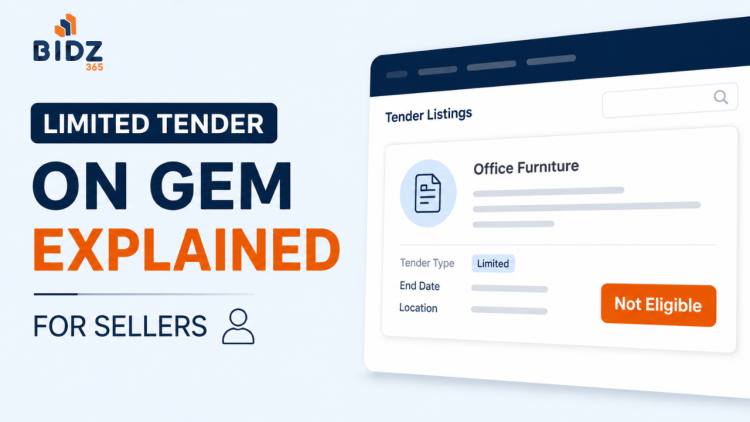
Limited tendering on GeM is available only for CPSE buyers, and participation is restricted to the sellers the buyer selects. The system also shows a “Not Eligible” status to sellers who are not allowed to participate. In other words, eligibility is not general; it is buyer-controlled and bid-specific.
The buyer can select up to 100 bidders for a limited tender. That gives some room for multiple eligible sellers, but it still keeps the process restricted. Sellers should therefore focus on building a strong profile, maintaining correct seller information, and staying relevant to CPSE procurement needs.
How the buyer side effects sellers
Buyers must choose a reason for limited tender from a dropdown and provide undertakings related to GFR compliance. They also need to upload competent authority approval for a limited bid. This tells sellers that limited tendering is not random; it is a compliance-driven procurement approach.
The buyer also sees seller names during bid creation, and a representation window is available to sellers. However, non-CPSE sellers who are not eligible cannot participate in CPSE-restricted bids, and the platform blocks them from continuing.
Common seller mistakes
One common mistake is assuming that every GeM bid is open to everyone. That is not true for limited tendering. Another mistake is ignoring notification timing, because selected sellers are the only ones who receive the opportunity and can participate.
Sellers also sometimes miss the importance of classification. If your products or services are not properly mapped to the right category, you may lose visibility when buyers build restricted bids. Finally, many sellers do not understand the restrictions on custom and BOQ-based bids, where this limited tender feature is not applicable.
How Bidz365 helps sellers
This is exactly where Bidz365 consulting can make a difference. Many sellers know GeM exists, but they struggle with bid selection, bid response planning, seller profile optimization, and understanding how restricted procurement works. Bidz365 helps sellers move from random participation to a structured, strategic approach.
With Bidz365, sellers can get support in areas such as:
- GeM seller onboarding and profile optimization.
- Bid identification and opportunity filtering.
- Limited tender interpretation and participation guidance.
- Documentation readiness and compliance support.
- Strategic consulting to improve bid conversion.
For sellers who want to grow in government procurement, this kind of support saves time and reduces avoidable mistakes. Instead of treating GeM as a confusing portal, you can treat it as a business channel with a repeatable winning process.
Final perspective
Limited tender on GeM may look restrictive, but for sellers it can be a valuable route to serious procurement opportunities. The key is to understand that this is not a mass-market bid format; it is a selective process with defined eligibility, buyer controls, and strict participation rules. Sellers who understand this structure can prepare better and act faster.
If you want to turn GeM from a confusing portal into a practical sales channel, Bidz365 consulting can help you do that with clarity and strategy. The sellers who win are usually not just the cheapest ones; they are the ones who understand the system, stay compliant, and respond with confidence.