

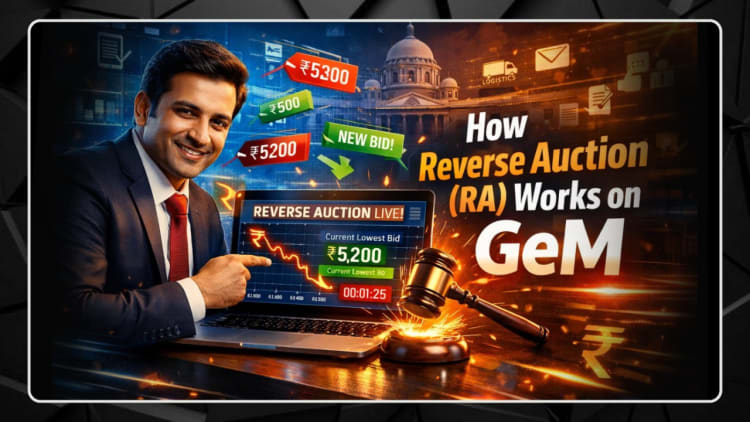
Government procurement in India has evolved rapidly with the adoption of digital platforms like GeM (Government e-Marketplace). One of the most powerful and misunderstood mechanisms on GeM is the Reverse Auction (RA).
If you are a seller or MSME participating in bids, understanding how Reverse Auction works on GeM can significantly increase your chances of winning orders - while protecting your margins.
This guide outlines the process, rules, eligibility, risks, and strategies - rooted in GeM procurement norms and the Ministry of Finance’s GFR 2017 compliance framework.
What is Reverse Auction?
A Reverse Auction is a real-time online price reduction process where technically qualified bidders compete by lowering their prices to become the L1 (lowest bidder).
Unlike a normal auction (where buyers increase bids), in Reverse Auction:
- Buyer sets requirements
- Sellers compete by decreasing price
- Lowest compliant bidder wins
It is used in competitive procurement to ensure:
- Transparency
- Fair price discovery
- Value for public money
Where Reverse Auction is Used on GeM
Reverse Auction is generally used in:
- High-value procurement
- Standardized products
- Competitive categories with multiple sellers
- Rate contracts
- Bulk procurement
Buyers on GeM can enable Reverse Auction during:
- Regular Bid
- Custom Bid
- BOQ Bid
Key Rules in Reverse Auction GeM
- H1 Elimination Rule
- The bidder with the highest quote (H1) is normally not allowed to participate in the Reverse Auction.
- If only 2 or 3 bidders are technically qualified, H1 is not eliminated and can join the RA.
- 50% Rule (Percentage-Based Elimination)
- When many bidders qualify technically, only the lowest 50% (ranked by price) are allowed into the RA.
- This ensures only competitive pricing moves forward.
- “Lowest 5 Stay” Mechanism
- In large procurements, even after applying the 50% rule, the system ensures enough bidders remain - typically the lowest 5 - to maintain healthy competition.
Step-by-Step: How Reverse Auction Works on GeM
The Reverse Auction process on GeM follows these structured steps that ensure transparency, competition, and efficient price discovery:
Step 1: Buyer Creates Bid
A government department creates a bid on GeM specifying:
- Technical specifications
- Quantity
- Delivery timeline
- Eligibility criteria
- Bid type (with Reverse Auction enabled)
Step 2: Sellers Submit Technical + Financial Bids
Interested sellers submit:
- Technical compliance documents
- Required certifications
- Initial financial quote
At this stage, it works like a normal tender.
Step 3: Technical Evaluation
Buyer evaluates technical bids.
Only technically qualified sellers move to the Reverse Auction stage.
This ensures:
- Only eligible bidders compete on price
- No compromise on quality
Step 4: Reverse Auction Invitation
Qualified sellers receive:
- Date & time of auction
- Duration of auction
- Starting price (usually lowest quoted price)
- Minimum decrement value (bid reduction step)
Step 5: Live Reverse Auction Session
This is the critical stage.
During the live session:
- Sellers can see the current lowest bid (without bidder identity)
- They can reduce price within defined decrement
- Multiple rounds of price reduction happen
- Auction auto-extends if last-minute bids are placed This continues until:
- Time expires without new lower bid Final lowest price becomes L1.
Step 6: Final Evaluation & Award
After auction:
- System identifies L1
- Buyer verifies compliance again
- Order is awarded to L1 bidder
Summary
Reverse Auction on GeM is a structured, transparent process where only technically qualified and competitive bidders move forward. Rules like H1 elimination, the 50% participation cutoff, and the Lowest-5 mechanism ensure fair competition and accurate price discovery. With expert-led guidance from Bidz365, sellers can better understand RA rules, avoid common mistakes, and sharpen their pricing strategy for competitive outcomes.
For sellers, especially MSMEs, understanding how RA filters bidders and drives real-time price reduction is crucial. A clear grasp of these rules helps businesses quote smarter, stay compliant, and improve their chances of securing government orders without compromising margins.